
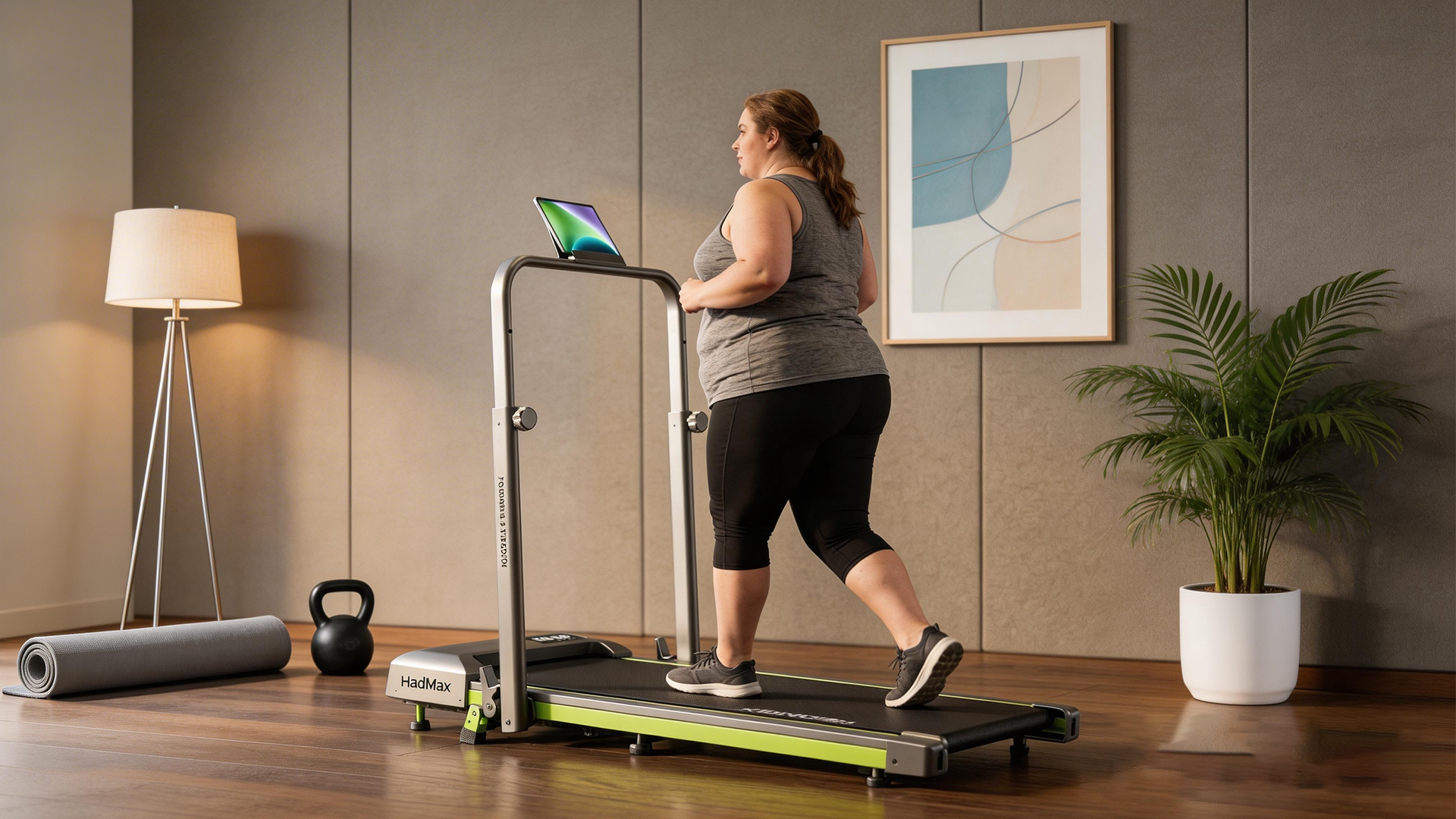
Let’s be honest for a second: if you have cranky knees, the word “running” probably sounds less like a workout and more like a threat. You want to lose weight. You know you need to move. But the moment your feet start pounding the pavement—or even the cushy belt of your treadmill—your knees start sending you angry text messages.
So, what’s the move? Do you hang up your sneakers and accept your fate on the couch?
Absolutely not.
There is a secret weapon hiding on your treadmill, and it doesn’t involve bouncing up and down until your joints sound like a bowl of Rice Krispies. I’m talking about the Incline.
If you’ve been overlooking the knee-friendly treadmill features for the sake of logging miles, it’s time to pivot. Here’s why incline walking benefits go way beyond just saving your cartilage—and why this “walk” might actually torch more fat than your neighbor’s 5k routine.
The Great Pounding: Why Running Isn’t Always the Answer
We’ve been conditioned to think that running is the gold standard for weight loss. It’s intense, it’s sweaty, and it feels like you’re working hard. But for anyone with knee issues—whether it’s patellofemoral pain syndrome, old meniscus tears, or just the general creakiness that comes with being a human adult—running is essentially taking a sledgehammer to a nail when you really need a screwdriver.
When you run, the impact force on your knees is roughly three to four times your body weight. That’s a lot of force. Every. Single. Stride.
If your form isn’t perfect (and let’s face it, after mile two, nobody’s form is perfect), that impact starts to wear down the protective cartilage or inflame the tendons. It’s not that running is “bad”; it’s just that running might be bad for you, right now.
Enter the slope.
The Physics of “Going Up”
When you crank up the incline on a treadmill, something magical happens. You stop slamming your joints into the machine and start engaging your muscles to lift you up.
Walking on an incline transforms the treadmill from a horizontal conveyor belt of potential joint pain into a vertical climbing machine that respects your anatomy.
Here is why low impact cardio is the cheat code for the knee-challenged weight loss warrior:
-
Zero Impact (Seriously, Zero): When you walk on an incline—even a steep one—one foot stays in contact with the belt at all times. There is no “flight phase.” No landing. No thud. You get all the cardiovascular benefits without the collision.
-
Glute Activation: Most runners (especially those with knee pain) are “quad-dominant.” When your quads are overworked and your glutes are sleeping on the job, your knees take the brunt of the force. Incline walking forces you to engage your posterior chain. When your glutes and hamstrings fire correctly, they act as shock absorbers for your hips and knees. Basically, a strong butt is the best knee brace you’ll ever buy.
-
Calorie Torching: This is the part that blows most people’s minds. You don’t have to run to burn fat. Walking at a steep incline (think 10% to 15%) at a brisk pace (3 to 4 mph) elevates your heart rate into the exact same “zone” as jogging, but without the joint stress. In fact, for many people, incline walking burns more calories per minute than jogging at a slow pace because the resistance is higher.
Why Your Treadmill’s Motor Matters (Or: Why Cheap Treadmills Lie)
Now, let’s get into the nitty-gritty of the machine itself. You might have tried incline walking before and felt… underwhelmed. Maybe the belt stuttered. Maybe the machine groaned louder than you did when you tried to set it to a 12% grade.
This is where the difference between a wimpy machine and a proper setup comes into play.
If you are planning to make incline walking your primary cardio modality, you absolutely cannot do it on a flimsy treadmill. When you’re walking uphill, you’re placing constant, sustained pressure on the belt. A standard treadmill with a 1.5 to 2.0 HP (Horsepower) motor is going to struggle. It might overheat, the belt might slip or hesitate, and that hesitation can throw off your rhythm (and potentially tweak your back).
This is why I always point people toward a machine with serious guts—specifically, a 3.0 HP motor.
A 3.0 HP motor isn’t just about speed; it’s about torque. It’s about maintaining a steady, consistent belt speed under the load of a human body climbing a steep grade. When you’re holding onto the handles (or bravely letting go) at a 12% incline, the last thing you want is for the belt to stutter because the motor is crying for mercy. A high-torque motor ensures that smooth, low impact cardio experience remains uninterrupted. It’s the difference between feeling like you’re climbing a mountain and feeling like you’re stuck in a mud pit.
How to Structure the Ultimate Knee-Friendly Fat Burn
Ready to ditch the running shoes (metaphorically—please still wear shoes) and hit the slopes? Here is a fun, effective workout that maximizes incline walking benefits without turning your knees into a liability.
The “I’m Not Running, But I’m Sweating Like I Did” Incline Protocol
-
Warm-up (3 minutes): 0% incline, 2.5 mph. Get the blood flowing.
-
The Build (5 minutes): Increase incline to 5%. Speed to 3.0 mph. Walk tall; don’t lean on the handles.
-
The Grind (20 minutes):
-
*Minutes 0-5:* Incline 8% / Speed 3.0–3.2 mph.
-
*Minutes 5-10:* Incline 10% / Speed 3.0–3.2 mph. (You should be breathing hard but able to say a few words).
-
*Minutes 10-15:* Incline 12% / Speed 2.8–3.0 mph. (Focus on driving through your glutes).
-
*Minutes 15-20:* Incline 15% / Speed 2.5–2.8 mph. (Lean forward from your ankles, not your waist. Hold on if you need balance, but try to let go as your core gets stronger).
-
-
The Cooldown (5 minutes): Drop incline to 0%, walk at 2.0 mph until your heart rate comes back down.
Do this three to four times a week, and you will notice something: your knees feel better after the workout than they did before. No ice packs needed. No limping to the car. Just the satisfying burn of a job well done.
The Verdict
Look, I get it. There’s a psychological satisfaction to saying “I went for a run.” It feels athletic. But if you’re trying to lose weight and your knees are staging a revolt, you have to work smarter, not harder.
Knee-friendly treadmill training isn’t about taking it easy; it’s about optimizing the stress on your body. By utilizing the incline, you unlock a form of low impact cardio that is actually more efficient at building glutes, safer for your joints, and equally effective at torching calories.
Just make sure the machine you’re using can handle the climb. Pair that steep grade with a robust 3.0 HP motor, and you’ve got a recipe for weight loss that doesn’t require a knee replacement by the time you hit your goal weight.
So, give the running a rest. Crank up the hill. Your knees will thank you—and honestly, so will your glutes.